> ## Documentation Index
> Fetch the complete documentation index at: https://docs.spirals.so/llms.txt
> Use this file to discover all available pages before exploring further.
# 🌵 Maximizing Climate Impact
> People will opt for earth-positive actions only once they are easier, cheaper and tastier.
 Our master plan to solving the climate crisis is to **fix broken incentives by
making earth-positive actions the default.** Becoming a member is a decision to
opt-in to this new incentive design and choose a better world.
## Broken Incentives cause systemic problems
Carbon Markets are a powerful financing vehicle to addressing the climate
crisis, yet they fall short in a few ways. For example, carbon markets:
* Drive symptom management rather than treating root causes --> there is not
enough of a feedback loop for causal treatment.
* Result in carbon reductionism --> it is difficult to measure complexity of
whole ecosystem health.
* Max out at neutrality --> offsets are designed to "undo an emission"; to solve
the problem, we need to go beyond neutrality.
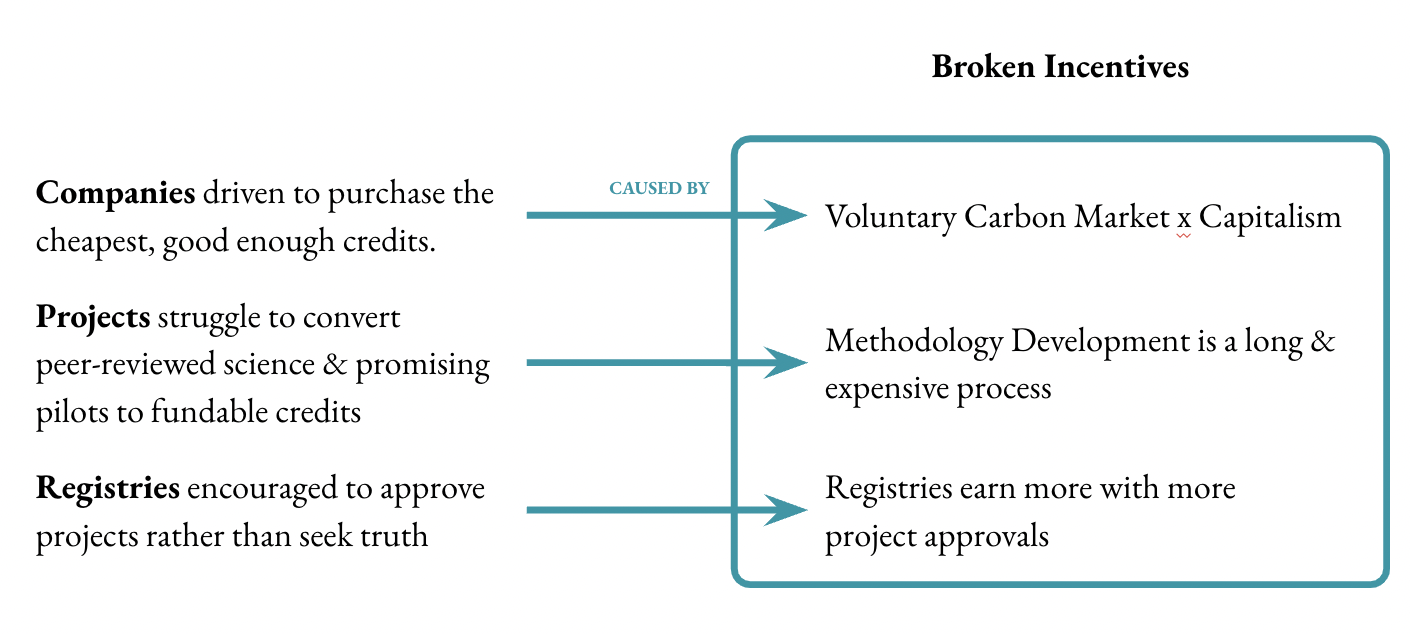
* Create "race to the bottom" mechanics --> offset buyers look for the cheapest
carbon credits (regardless of quality), giving they give the impression carbon
is a commodity and all credits are fungible.
Our master plan to solving the climate crisis is to **fix broken incentives by
making earth-positive actions the default.** Becoming a member is a decision to
opt-in to this new incentive design and choose a better world.
## Broken Incentives cause systemic problems
Carbon Markets are a powerful financing vehicle to addressing the climate
crisis, yet they fall short in a few ways. For example, carbon markets:
* Drive symptom management rather than treating root causes --> there is not
enough of a feedback loop for causal treatment.
* Result in carbon reductionism --> it is difficult to measure complexity of
whole ecosystem health.
* Max out at neutrality --> offsets are designed to "undo an emission"; to solve
the problem, we need to go beyond neutrality.
* Create "race to the bottom" mechanics --> offset buyers look for the cheapest
carbon credits (regardless of quality), giving they give the impression carbon
is a commodity and all credits are fungible.
 ## Spirals builds beyond carbon markets
**Spirals integrates climate impact into the backbone of our economy, enabling a
regenerative future.**
We are working on a new economy built on the rails of good, building an
ecosystem that rewards positive externalities by aligning economic and
ecological incentives.
## Spirals builds beyond carbon markets
**Spirals integrates climate impact into the backbone of our economy, enabling a
regenerative future.**
We are working on a new economy built on the rails of good, building an
ecosystem that rewards positive externalities by aligning economic and
ecological incentives.
 ### Shifting Focus From Symptoms to Causes
Climate action can broadly be broken down into two categories: symptom
management and causal change.
Most of what we’re used to identifying and associating with climate change are
symptoms — droughts, floods, crop failures, wildfires, habitat loss, extreme
temperatures and increased greenhouse gasses in the atmosphere. On the other
hand, causes are more nuanced, harder to pin-down and more complex to address.
Extractive economics, lack of education, loss of connection to the natural
world, a poorly built human environment and destructive agricultural practices
are all contributing causes to the negative symptoms we associate with climate
change.
As we go through this necessary paradigm shift towards systems that are better
suited to support human civilization, it will undoubtedly be necessary to
address these acute symptoms we are experiencing. But just like with any
illness, symptom management without a conscious effort to remedy the root
cause(s) of said illness is just a temporary solution.
So what does a more permanent solution look like? Can we "solve" climate change?
To seriously answer those questions we need to take a holistic look at observed
patterns of our planets climate.
[Read the full blog post](https://medium.com/spirals-protocol/our-approach-to-climate-impact-focus-on-causes-not-symptoms-e402582cae3a)
to learn more about our Climate Impact philosophy.
### Shifting Focus From Symptoms to Causes
Climate action can broadly be broken down into two categories: symptom
management and causal change.
Most of what we’re used to identifying and associating with climate change are
symptoms — droughts, floods, crop failures, wildfires, habitat loss, extreme
temperatures and increased greenhouse gasses in the atmosphere. On the other
hand, causes are more nuanced, harder to pin-down and more complex to address.
Extractive economics, lack of education, loss of connection to the natural
world, a poorly built human environment and destructive agricultural practices
are all contributing causes to the negative symptoms we associate with climate
change.
As we go through this necessary paradigm shift towards systems that are better
suited to support human civilization, it will undoubtedly be necessary to
address these acute symptoms we are experiencing. But just like with any
illness, symptom management without a conscious effort to remedy the root
cause(s) of said illness is just a temporary solution.
So what does a more permanent solution look like? Can we "solve" climate change?
To seriously answer those questions we need to take a holistic look at observed
patterns of our planets climate.
[Read the full blog post](https://medium.com/spirals-protocol/our-approach-to-climate-impact-focus-on-causes-not-symptoms-e402582cae3a)
to learn more about our Climate Impact philosophy.