> ## Documentation Index
> Fetch the complete documentation index at: https://docs.spirals.so/llms.txt
> Use this file to discover all available pages before exploring further.
# ❓ FAQs
> In case you couldn't find the answers to your questions elsewhere... 🙈
#### Risks
Staking with Spirals means that you can always redeem the staked asset. Let's
break down what that means for token supported today.
### Celo
When you stake Celo with Spirals, that is staked on validators that power Celo's
L1 consensus mechanism. Since L1 staking guarantees that staked Celo can be
withdrawn\*, Spirals is also able to make this claim. Today, we do this through
an audited liquid staking protocol called
[Staked Celo](https://docs.stcelo.xyz/).
*\*One small caveat here is*
[*slashing penalties*](https://docs.celo.org/protocol/pos/penalties)*. This is
why Staked Celo has a strict criteria for validator selection & rotation to
minimize the probability of slashing.*
### cUSD
When you stake cUSD with Spirals, our vaults deposit cUSD as collateral into a
decentralized lending protocol called [Moola Market](https://moola.market/)
(fork of Aave V2). Moola Market tracks a health factor for each depositor that
measures the value of their collateral against the value of their debt. If the
ratio falls below 1 (loan becomes under collateralized), then a liquidation
event is triggered.
This stability mechanism ensures that Moola's lending pools are
over-collateralized so that there should always be enough liquidity to allow our
vaults to withdraw cUSD on behalf of a Spirals staker. On top of that, Spirals
does not take out any loans on Moola Market so our underlying cUSD collateral is
safe and will never be liquidated.
Yes! We completed our first audit with [Verilog
Solutions](https://www.verilog.solutions/audits/spirals/) on September 12th, 2022.
#### Impact
Today, the impact of a Spirals user can be understood as "the amount of positive
climate work I've helped bring to life." Although not every project in the
portfolio focuses on sequestering carbon, we use tCO2 (tons of carbon) as a base
unit to understand our physical climate impact and an estimated cost of \$15/ton
for nature-based carbon removal.
For example, let's say we have a user who is staking $10,000 across all green
token vaults (5% avg APY) and leaves it staked for a year. Then this user is
contributing $500 to climate projects, which equates to 33.33 tCO2 of physical
climate impact.
Conversion to other units like number of miles walked instead of driven was
calculated using numbers used by an open-sourced carbon footprint calculator
published by Berkley researchers:
[https://coolclimate.berkeley.edu/calculator](https://coolclimate.berkeley.edu/calculator)
No, because users of Spirals do not get to claim the carbon offset associated
with their yield contributions. This is instead understood to be the amount of
positive climate work they've helped bring to life, but is not contributing to
their individual carbon neutrality.
#### Governance
An independent council of climate experts review each climate impact project to
ensure we are listing high quality projects. This process will be eventually
completely open-sourced with an opportunity for SPRL token holders to become
engaged as well.
Learn more about how that works today
[here](https://docs.spirals.so/climate-impact/project-review-process).
Eventually we will be, yes! Our approach to building Spirals is best summarized
by ***progressive decentralization***.
For now we are mostly making decisions as a core team to learn quickly and
understand how things can be systematized. Our intention is to gradually
transition the decision-making process to on-chain governance coordinated by the
\$SPRL token. More on that soon!
#### Supported Platforms
Today we support Celo. Soon we will support Ethereum and Polygon as well.
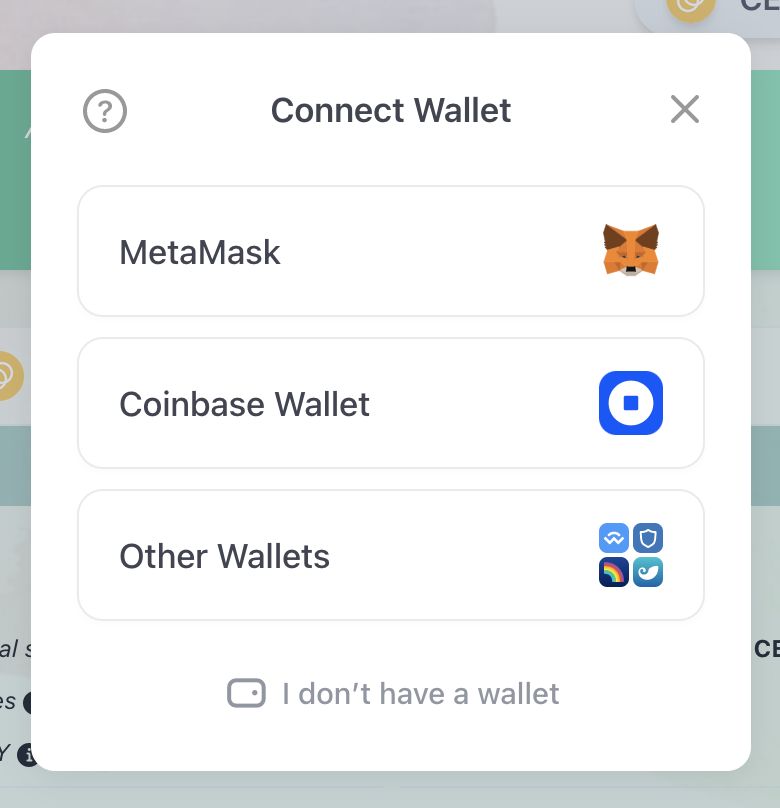
Today we support Metamask, Coinbase Wallet and most other wallets through
WalletConnect (Valora, Rainbow Wallet, etc.).
We also support Gnosis Safes for multisig staking!
 #### Fees
As a quick refresher, there are 3 types of projects on Spirals:
* **Collection** - climate impact projects funded through forward contracts,
part of the default Spirals Collection
* **Impact** - climate impact projects, either `verified` or `pending review`
by climate council
* **Ecosystem** - projects that strengthen the ReFi ecosystem
The fees for staking depends on the type of project you are supporting. If a fee
applies, it is taken from the staking yield you earn through the protocol, which
means that you will still be able to withdraw 100% of your principal deposit.
* **Collection -** no fees
* **Impact** - 2% for verified projects, 5% for unverified projects
* **Ecosystem** - flat 5% fee
As a project, there are **no fees** for listing your project and setting up a
project page 🙂
#### Fees
As a quick refresher, there are 3 types of projects on Spirals:
* **Collection** - climate impact projects funded through forward contracts,
part of the default Spirals Collection
* **Impact** - climate impact projects, either `verified` or `pending review`
by climate council
* **Ecosystem** - projects that strengthen the ReFi ecosystem
The fees for staking depends on the type of project you are supporting. If a fee
applies, it is taken from the staking yield you earn through the protocol, which
means that you will still be able to withdraw 100% of your principal deposit.
* **Collection -** no fees
* **Impact** - 2% for verified projects, 5% for unverified projects
* **Ecosystem** - flat 5% fee
As a project, there are **no fees** for listing your project and setting up a
project page 🙂